← The fields
The book, forthcoming

Some people's work travels. Yours stays close to you.

Counted On names the real reason, lets you recognise it through Alva, and gives you a practice to close the gap.
What progress means here

Progress is work others begin to carry.

Evidence

Work, judgment, credit and access travel together.

That is the same claim as the line on the cover. How solid work becomes work that travels says what the book is. Work others begin to carry says what would count as progress.

Where you recognise it

Judgment arrives. Protection intercepts it. The work never gets to use what you saw.

Not because it lacks quality. Quality was never the problem.

You know it as a feeling before you know it as a problem. Trusted for delivery. Invited too late for direction.

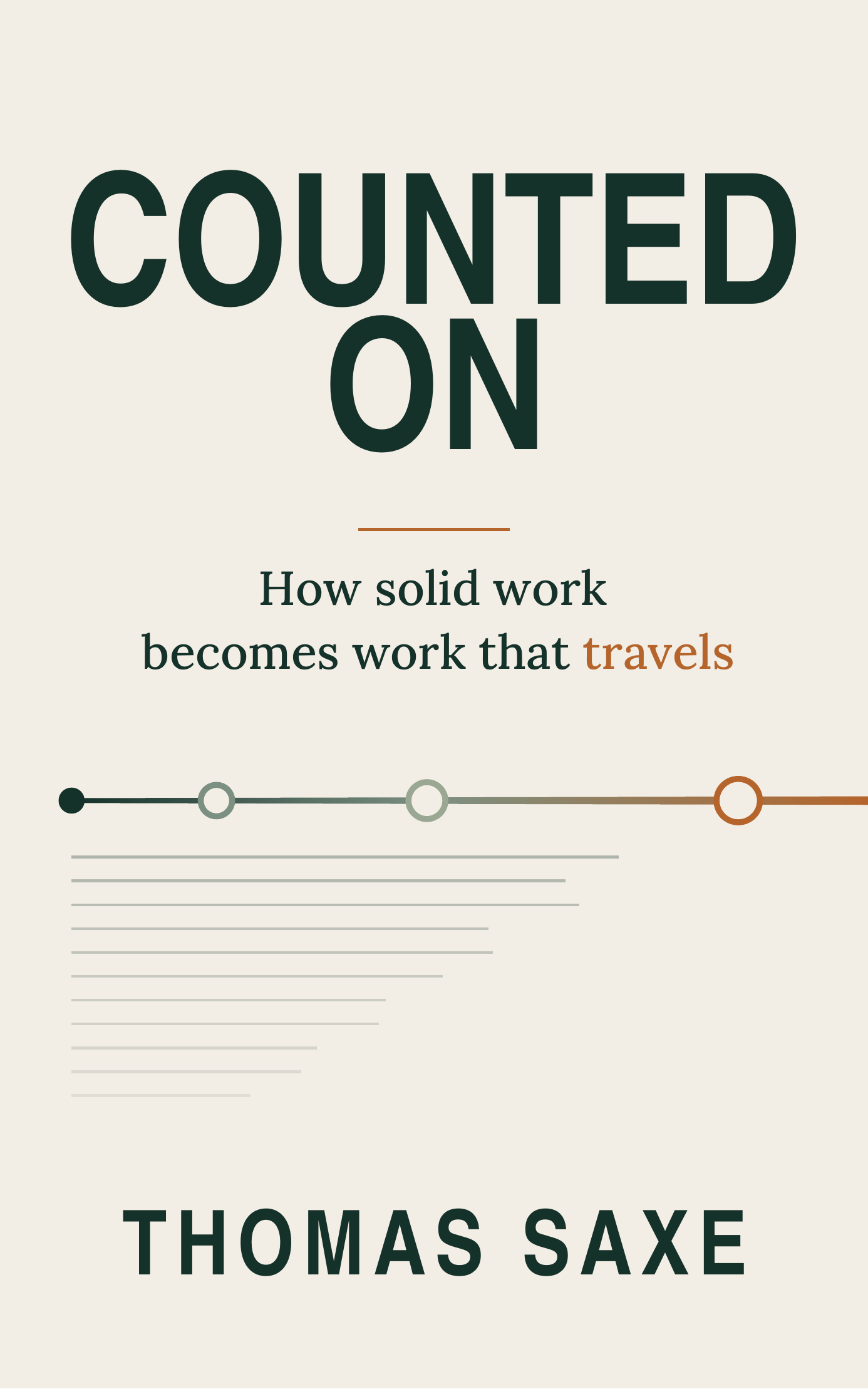
Counted On: How solid work becomes work that travels by Thomas Saxe
What is actually happening

The problem is quieter, and it sits in one of three places.

The real gap is not visibility. It is usability. That distance has a name: The Usability Gap.

It is not always you. And it is still always your move. Some gaps are yours to close. Some gaps are signals about the room. The book does not turn every problem into self-improvement, and it does not pretend you control what the room does next.

How the book works

A method experienced as a story.

You meet Alva before anything is explained to you. You predict what she should do. She acts. Reality answers, and it is often not what you expected. Then the book names what just happened, and hands you the next move to run in your own work.

Five shifts, each closing one part of the distance between private capability and work that travels. Each ends with one small action you can take this week, and evidence to read afterwards.

You predict→Alva acts→Reality answers→You recalibrate→Build next
What this is not

Most career advice tells you to become more visible.

Counted On teaches you to make your work more usable, and then to read whether the work is carrying your judgment, credit and access with it.

Used is not carried. The work may be used. The question is whether you are carried with it.

You cannot make yourself counted on. You can only build what makes it possible.

What changes

You will know it is working when the signs get specific.

You deliver good work and hear nothing back.→People ask for your read earlier, because the work has made your judgment easier to use.
The room turns to someone else.→Your work is used cleanly, and its source stays legible.
Your judgment arrives too late or stays too private.→Your thinking is repeated accurately by other people.
You are trusted for delivery but not yet counted on for direction.→People plan with your work in mind, before the next task exists.
Your work is used, but the room does not connect it back to your judgment.→Your work, judgment, credit and access begin moving together.
Evidence

What travelled with the work: the work, the wording, the judgment, the credit, the access, or all five.
Not from invisible to admired. From private to usable. From effort to consequence. From overlooked to counted on.

An excerpt from the book

One exercise, taken directly from Counted On.

Choose one small move you can make on your next meaningful piece of work to increase the chance that it will travel well. For example:

Use that move on the next real piece of work you produce. Notice what changes.

"My last piece of work stopped or travelled because X. The friction sat mostly in Y. The move I will make on the next piece is Z."

This is one exercise from one chapter. Every shift ends the same way: one small action to run this week, and evidence to read afterwards. No evidence is also evidence.

The book

Counted On now has its own home.

Visit counted-on.com ↗

Read more about the book and try The Discomfort Map at counted-on.com. Publication news is shared on LinkedIn.

Continue